Plumbing first: why agentic AI makes API standardization non-negotiable
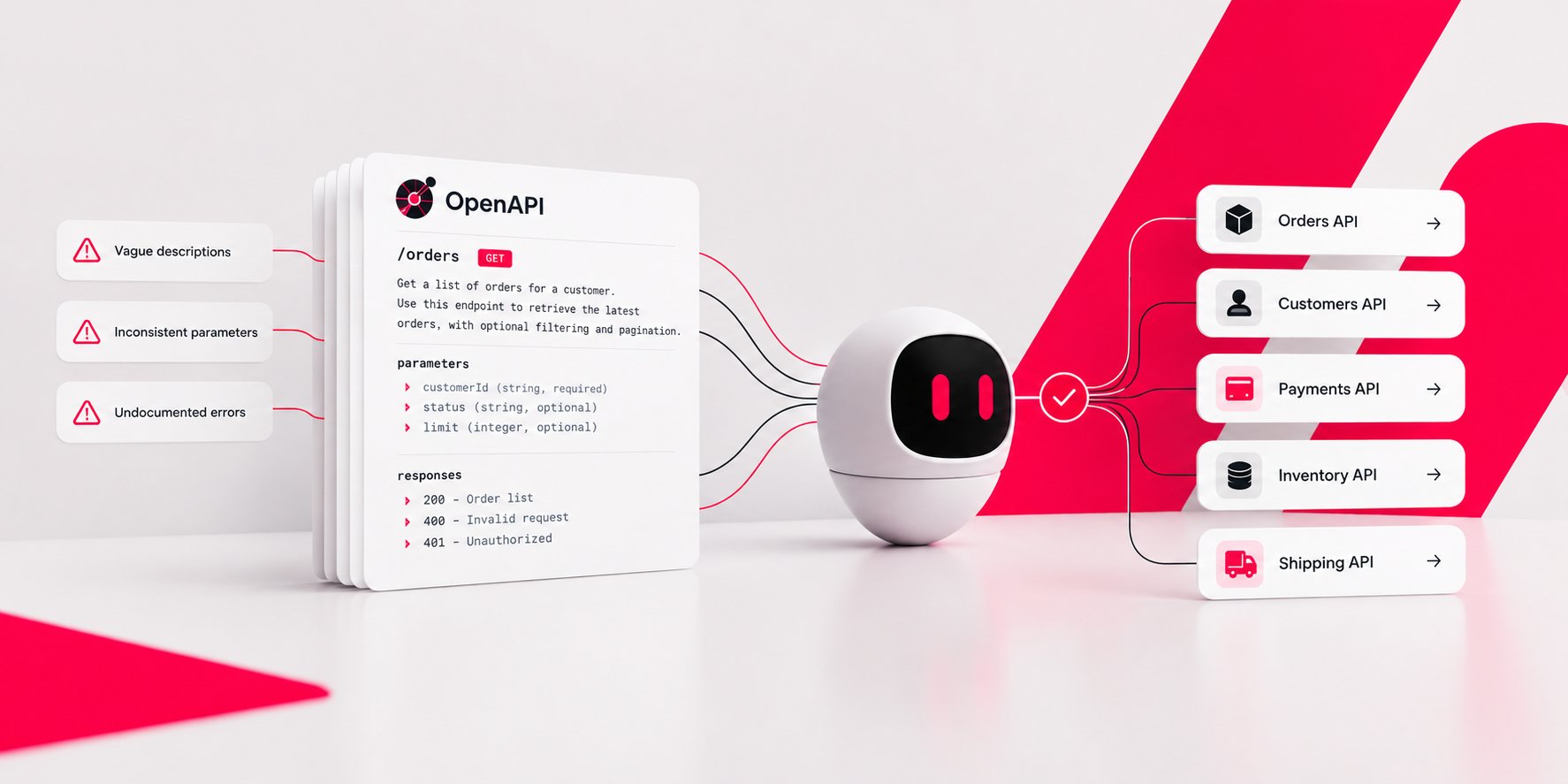
For years, an inconsistent API mostly cost developers time. With agentic AI, it can cost you a wrong decision. When an AI agent consumes APIs as tools, every vague description, inconsistent parameter and undocumented error becomes part of what that agent has to interpret.
A developer can work around bad API documentation. They inspect a response, ask a colleague or try another payload. An agent cannot rely on that kind of tribal knowledge. It has to choose the right tool, construct the right request and interpret the result based on the information you expose to it.
That changes the nature of API governance. What used to be a productivity problem is becoming a correctness and control problem.
Your OpenAPI spec is becoming part of the prompt
With MCP support in advance API platforms, existing API operations can be exposed as tools to agentic applications. That means your OpenAPI specification is no longer only documentation for developers. It increasingly becomes machine-readable context for an agent.
Operation descriptions help explain intent. Parameter schemas define what can be sent. Response and error schemas determine what the agent can understand after the call.
Compare a vague description such as “description: Returns data” with one that explains what the operation does, when it should be used, what constraints apply and how duplicate requests are handled. A human developer may be able to interpret both. An agent has much less room for ambiguity.
Research published in 2026 makes that distinction clear. A study of 16 production APIs and around 600 endpoints found 2,450 documentation and REST-related “smells”, with deficiencies in every operation examined. The same research showed that agents struggled with task planning, tool selection and payload construction.
The conclusion is important: a technically valid OpenAPI specification is not automatically agent-ready.
Spec quality increasingly becomes tool quality. And tool quality influences agent behavior.
Governance cannot live in a review meeting
Most enterprises already have API governance. They have naming conventions, security standards, architecture principles, and review processes. The problem is that too much of that governance still depends on people manually checking whether standards were followed.
That does not scale well across large API estates. It already creates friction for human teams: Postman reports that 55% of developers struggle with inconsistent documentation, while 34% cannot find existing APIs within their own organization. Contract testing adoption remains low.
Agentic consumption makes those weaknesses more visible. The answer is not more review meetings, but governance that is embedded in the lifecycle itself.
At AppyThings, we call this governed-by-design: embedding standards, security and validation directly into development and deployment instead of checking them afterwards. That way, governance does not just reduce risk. It also makes collaboration easier and helps teams move faster.
What automated governance should look like
Making an API estate agent-ready does not require a completely new governance model. It requires strengthening the one you already have.
A practical lifecycle looks like this:
-
Design contract-first. Treat OpenAPI as the source of truth and translate your style guide into automated rules. Tools such as Spectral can validate naming conventions, error models, pagination patterns and security schemes before an API moves forward.
-
Add an AI-readiness gate. Traditional validation asks whether a specification is structurally correct. Agent readiness asks whether an agent can understand what an operation is for, when to use it and what the result means. That means checking for clear descriptions, constrained parameters, examples, idempotency, and explicit error semantics.
-
Decide where Arazzo or Overlay add value. Arazzo can describe multi-step API workflows. Overlay can enrich an existing API description without changing the original source. Neither is automatically required, but both can be useful depending on the use case.
-
Automate promotion. APIs, events and MCP servers should move through development, test and production via CI/CD, with contract and integration tests before deployment. This is already part of AppyThings’ Foundation Setup approach.
-
Publish tools in a governed way. An MCP tool should have an owner, an access model and a clear place in the wider estate. API products can carry quotas and entitlements, while API hub registration makes tools discoverable and attributable.
-
Keep governing after production. A specification changes. An operation is deprecated. Ownership changes. A tool becomes dormant. Those changes should automatically trigger the same checks again.
That last point matters most. The next agent use case should inherit the governance of the previous one instead of rebuilding it from scratch.
Standardization is what makes an estate composable
Agentic AI strengthens the case for further API standardization. Consistent error models allow orchestrators to handle failures uniformly. Consistent authentication patterns make identity and authorization easier to implement once and reuse. Consistent pagination, filtering and naming conventions make workflows easier to compose. And consistent ownership and discovery metadata reduces duplication across teams.
Standardization is not about making every API identical. It is about reducing the amount of special knowledge required to use each one.
That is what allows a relatively small platform team to support many agentic use cases. AppyThings’ architecture approach is built around that same principle: standardize development, create shared guardrails and turn the integration estate into a foundation for future digital and AI initiatives.
Not every API needs to become agent-ready
There are trade-offs. Adding new rules introduces pipeline noise, especially for existing APIs that were never designed with agentic consumption in mind. A sensible rollout can therefore start with warnings and gradually turn the most important rules into blocking errors.
Overlay can help enrich specifications you do not own, but it also creates another artefact to manage. And most importantly, not every endpoint needs to become an MCP tool.
The goal is not maximum exposure. It is selective, governed exposure of the APIs that actually create value for agentic use cases.
Three questions to test your readiness
Ask yourself:
-
Could an LLM, reading only your OpenAPI specifications, reliably choose and call the right operation for a common business task?
-
Does anything prevent an API operation with a vague or empty description from reaching production today?
-
If a team improves its specification tomorrow, does that improvement automatically reach the MCP tool your agents consume?
If the answer is no, your next agentic project may not need another AI framework first. It may need better plumbing.
At AppyThings, we ready your APIs for agentic AI
Validating API specifications, assessing AI readiness, identifying where Arazzo or Overlay add value, and building repeatable MCP enablement into existing API management and CI/CD processes.
The objective is not to create a separate AI layer. It is to build a secure, governed and transparent control layer through which agents can safely interact with your enterprise systems.
Your spec is now part of the prompt. Govern it like one.