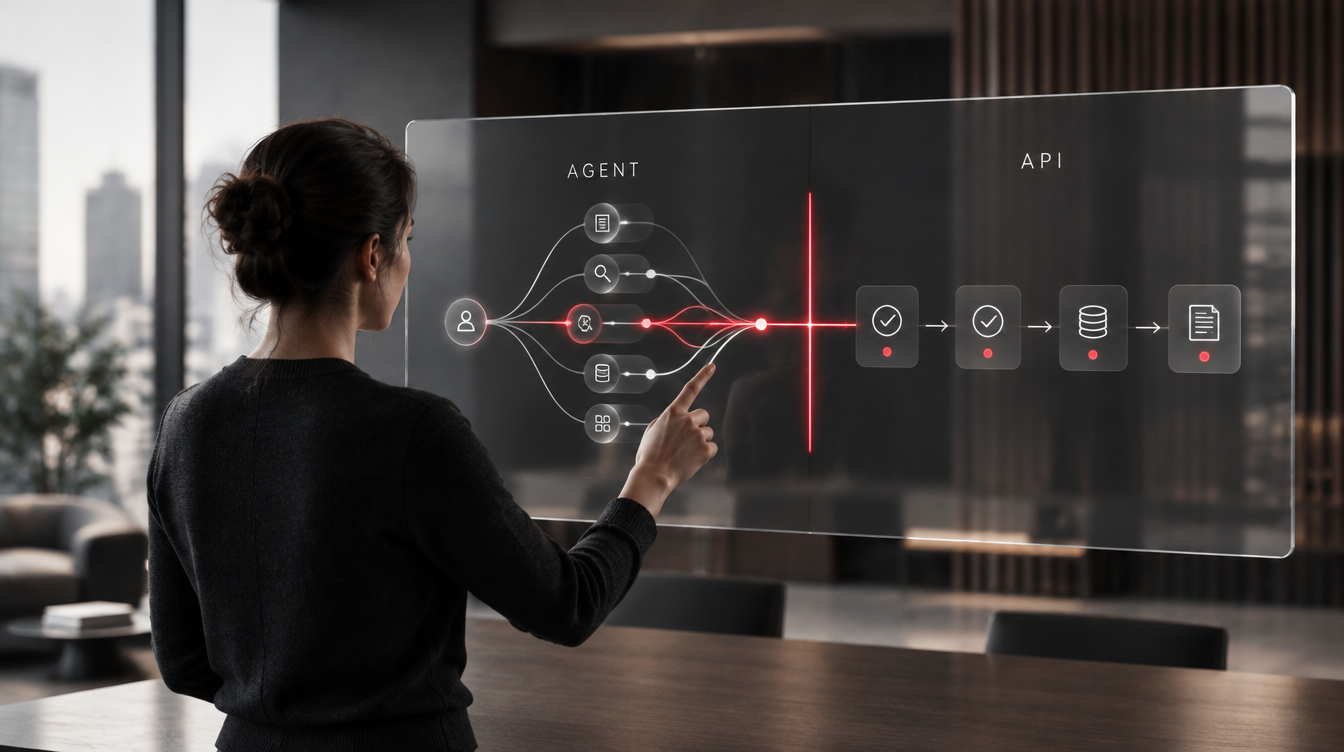
AI is moving from answering questions to taking action. Autonomous agents can retrieve data, call APIs, trigger workflows, and interact directly with enterprise systems. That creates new opportunities but also changes the security equation. The more autonomy you give an agent, the more important it becomes to control what it can access, what it can do, and on whose behalf it is acting.
From user access to agent access
Traditionally, organizations controlled the digital experience themselves. Users interacted with a website or application, authenticated themselves and performed predefined actions through interfaces the organization designed.
Agents change that model.
A user can simply express an intent: check an account, retrieve information, or execute a task. The agent then determines which tools it needs and interacts with enterprise systems on the user's behalf.
That introduces a new layer between user intent and your systems. And that layer needs its own controls.
Who is actually accessing your systems?
Identity is one of the first questions organizations need to solve.
In some scenarios, an agent acts on behalf of a user. User delegation, for example through OAuth, allows existing user permissions to remain part of the authorization flow.
But agents increasingly need an identity of their own as well. Technologies such as SPIFFE and SPIRE can provide workloads with verifiable, short-lived identities instead of relying on static credentials.
This distinction matters. Your architecture needs to understand both who requested an action and which agent is executing it.
Without that context, it becomes difficult to determine whether an action is legitimate, let alone audit it afterwards.
An authorized agent shouldn't automatically be authorized for everything
Authentication is only the beginning. Once an agent has access, you still need to control what it can do.
One concern is the confused deputy problem. An agent may have broader permissions than the user instructing it and could unintentionally use those privileges to access or expose information the user should never receive.
Authorization therefore needs to be granular and contextual. An agent should only access the systems, data, and operations required for a specific task.
The same principle applies to consumption. Unlike a human user, an agent can make hundreds of calls within seconds — or get stuck in a loop. Quotas and rate limiting help prevent runaway agents from overwhelming backend systems or generating unexpected costs.
Let AI interpret. Let deterministic systems execute.
There is another important boundary to define: what should the LLM decide, and what should your existing systems handle?
LLMs are probabilistic by nature. That makes them powerful for interpreting language, understanding intent and deciding which tool to use. But that doesn't make them the right place for every business operation.
Calculations, transactions and other actions that require exact, repeatable outcomes should remain deterministic.
An agent might understand that a customer wants to change a subscription, for example. But the actual validation, pricing, and transactions should still be handled by controlled APIs and backend systems.
In other words: use AI for inference, and trusted enterprise systems for execution.
Agent control is an architectural requirement
Agent control isn't about restricting AI until little value remains. It's about creating conditions in which autonomous agents can safely become part of enterprise processes.
That means combining identity, authorization, rate limiting, and controlled access to deterministic tools with the governance and observability needed to understand what agents are doing.
Because as agents become more autonomous, simply securing individual APIs is no longer enough. Organizations need a control layer that governs the interactions between agents, users, and enterprise systems.
The companies that prepare that foundation today will be better positioned to move beyond isolated AI experiments and integrate agents into critical processes without giving up control.